

SEO for Restaurants in Lahore: A Practical Google Maps Guide
Lahore's restaurant scene is fierce — and hungry customers are searching Google right now. This step-by-step local SEO guide shows you how to rank on Maps and search, and turn "biryani near me" into bookings.
 SEO
SEO
When someone searches for “best biryani near me,” “family restaurant in Gulberg” or “karahi in DHA Lahore,” they are rarely doing casual research. They are deciding where to eat, order or make a reservation.
Restaurant SEO helps your business appear during that decision. It improves how clearly Google understands what you serve, where you are located and why customers may choose you. The goal is not simply to generate website traffic. It is to earn more calls, direction requests, reservations, WhatsApp messages and orders.
This guide explains how an independent Lahore restaurant can build stronger visibility on Google Search and Google Maps without relying on shortcuts or keyword stuffing.
How Google ranks local restaurants
Google says local results are mainly determined by relevance, distance and prominence.
- Relevance is how closely your business matches the customer’s search. Correct categories, a detailed menu, useful attributes and clear website content help Google understand your restaurant.
- Distance is how close the restaurant is to the location used in the search. You cannot optimize your way around geography, but an accurate address and map pin help Google calculate it correctly.
- Prominence reflects how established and well known a business appears. Reviews, links, articles, directory references and general organic search visibility can contribute to this signal.
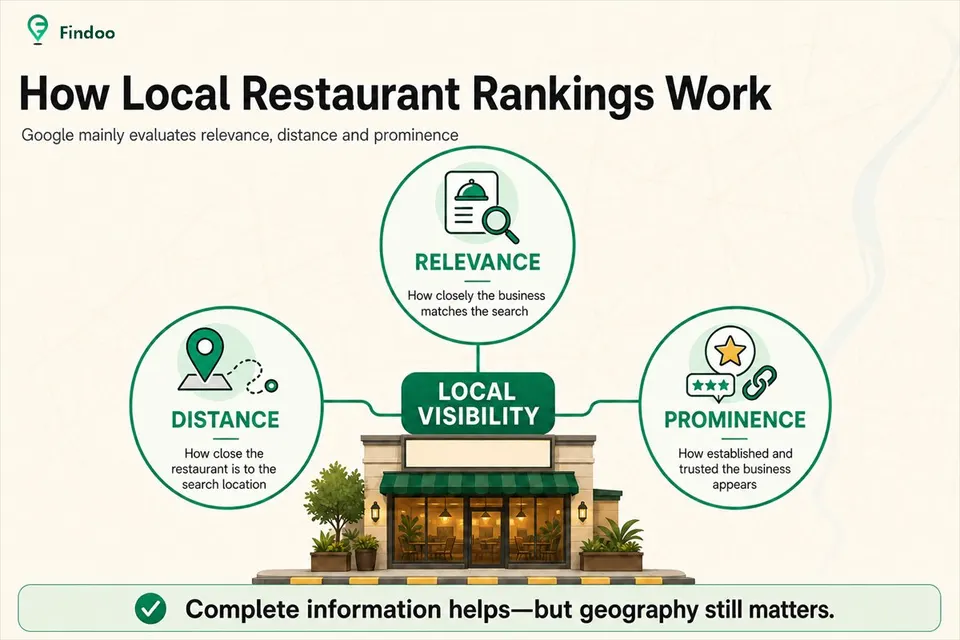
Local restaurant visibility depends on relevance, distance and prominence working together.
No restaurant can purchase or request a better organic local ranking. The practical strategy is to make the business accurate, relevant, trustworthy and easy for customers to use. See Google’s explanation of local rankings.
1. Claim and verify your Google Business Profile
Your Google Business Profile is the foundation of restaurant SEO. Claim the correct profile, complete verification and check for duplicate listings before making other changes.
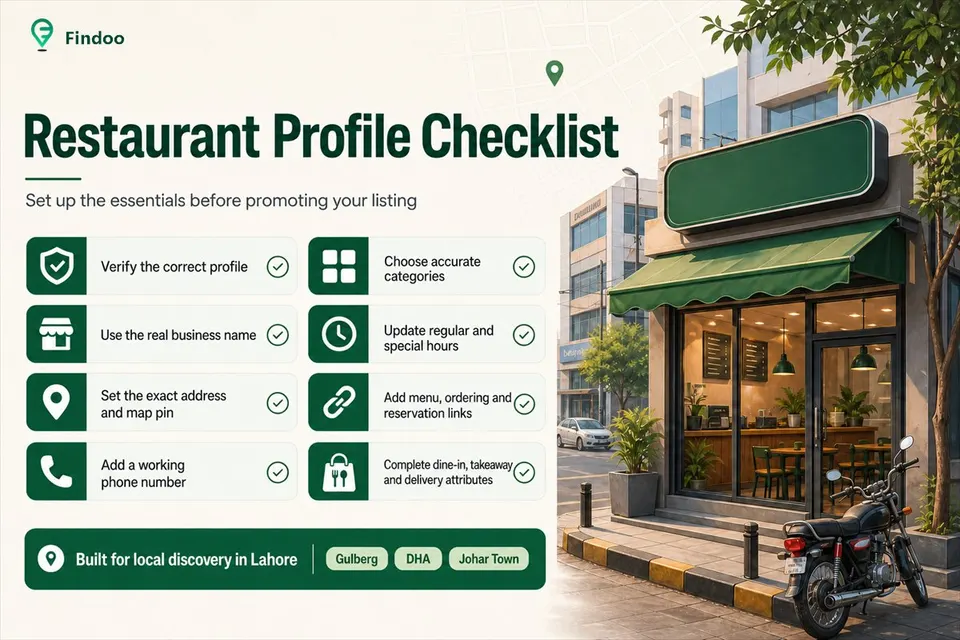
Complete the important fields:
- Use the restaurant’s real-world name as it appears on its sign and menu.
- Add the exact customer-facing address and place the map pin correctly.
- Use a working local phone number.
- Link to the restaurant’s official website or best ordering page.
- Add regular and special opening hours.
- Select the most accurate primary category.
- Add useful secondary categories only when they genuinely apply.
- Complete available attributes such as dine-in, takeaway, delivery, outdoor seating or wheelchair accessibility.
Do not add neighborhoods, cuisine keywords or promotional language to the business name unless they are part of the genuine brand name. That can violate Google’s profile guidelines and create avoidable risk.
2. Choose categories that describe the restaurant precisely
“Restaurant” may be technically correct, but a more specific available category can communicate greater relevance. Depending on the business, that might be Pakistani restaurant, barbecue restaurant, biryani restaurant, cafe, Chinese restaurant or fast-food restaurant.
Choose the category that best represents the restaurant’s main offering as the primary category. Add a small number of accurate secondary categories for meaningful additional services or cuisines.
A restaurant known primarily for Lahori karahi should not add every cuisine category merely to appear for more searches. Irrelevant categories create a confusing profile and do not build genuine relevance.
3. Add the menu, ordering and reservation paths
A customer should not have to search through Instagram posts to find the menu or current prices. Add the menu to the profile and keep the website version mobile-friendly.
Where available, configure:
- Menu link
- Online-ordering link
- Reservation link
- WhatsApp or direct-contact option
- Delivery and takeaway attributes
- Current price information
Test every path on a phone. Customers should be able to move from a local search to a menu, call, booking or order in a few taps.
If the restaurant uses Food panda or another delivery marketplace, keep its core information consistent with the official website and Google profile. Do not let an old number, address or menu remain active on a third-party platform.
4. Target cuisine, dish and neighborhood searches
Broad phrases such as “restaurant Lahore” are highly competitive and often vague. Independent restaurants usually have a better opportunity when their pages reflect the combination of dish or cuisine + neighborhood + customer need.
Examples include:
- Mutton karahi in Gulberg
- Family restaurant in DHA Phase 5
- Halwa puri near Johar Town
- Late-night cafe near M M Alam Road
- Restaurant with outdoor seating in Lahore
- Iftar buffet in Model Town
Use phrases only where they accurately describe the business. Place them naturally in page titles, headings, menu descriptions, branch pages and supporting articles. Avoid repeating the same phrase unnaturally in every paragraph.
The website should also answer practical questions diners ask: Is parking available? Is the restaurant suitable for families? Does it accept card or mobile payments? Is a reservation needed? Is it open after midnight?
These details make the page more useful and help it match specific searches.
5. Create a useful page for every branch
Restaurants with branches in Gulberg, DHA and Johar Town should create a dedicated page for each location. Every branch page should contain genuinely location-specific information rather than a duplicated paragraph with the area name changed.
Include:
- Branch name, address and local phone number
- Embedded map and directions
- Opening and special hours
- Menu and ordering options
- Original interior, exterior and food photographs
- Parking, accessibility and seating information
- Nearby landmarks
- Reservation or WhatsApp button
- Reviews or testimonials that comply with platform policies
Link branch pages from the main locations page and relevant navigation. Each page should have a unique title, H1 and description.
6. Keep important business information consistent
Search engines compile local-business information from the official website, business profiles, public web pages, third-party data and user contributions. Google explains these sources in its Business Profile information guidance.
Keep the restaurant’s name, primary address and phone number substantively consistent across important platforms. Prioritize fixing material conflicts such as:
- Old or disconnected phone numbers
- Previous addresses
- Duplicate Google profiles
- Incorrect map pins
- Different restaurant names
- Permanently closed branches shown as open
Do not waste time trying to make every full stop or address abbreviation identical. Correctness and entity clarity matter more than cosmetic punctuation.
A complete Findoo business listing can give customers another accurate place to discover the restaurant and reach its ordering or WhatsApp channel.
7. Use authentic restaurant photography
Photos influence whether people call, visit or continue scrolling. Add clear and truthful images of:
- Signature dishes
- Exterior and entrance
- Dining room and seating
- Menu or counter
- Team at work
- Parking or accessibility where relevant
Use recent, well-lit photographs that represent the real experience. Excessive filters, misleading edits and generic stock images can create expectations the restaurant cannot meet.
Google recommends multiple representative exterior, interior and food photos, but it does not promise a ranking increase based simply on uploading more images. Treat photography as a visibility and conversion asset, not a guaranteed ranking trick. Review Google’s business-photo recommendations.
8. Build a policy-compliant review process
Review count and review score can contribute to local prominence, while thoughtful responses can help a restaurant stand out. The safest strategy is to make honest reviews easy for every genuine customer.
Create a Google review link or QR code and place it on receipts, table cards or the post-order message. Train staff to make a simple request after a positive interaction. Respond professionally to both praise and criticism.
Never offer free food, discounts, competition entries or other incentives in exchange for a review. Do not request only positive reviews or ask customers to remove legitimate criticism. Google requires reviews to reflect genuine experiences and prohibits incentivized review activity. See Google’s review guidance.
A useful response to a negative review should acknowledge the concern, avoid exposing personal information and offer an appropriate way to continue the conversation privately.
9. Keep hours accurate during Ramadan and holidays
Incorrect opening hours can cost a restaurant both trust and revenue. Update special hours for:
- Ramadan and sehri service
- Iftar opening times
- Eid holidays
- Public holidays
- Temporary closures
- Private events
Check the website, Google profile, Findoo listing, delivery platforms and social profiles at the same time. If customers repeatedly arrive to find the restaurant closed, no amount of optimization will repair the experience quickly.
10. Strengthen the restaurant website
A restaurant can appear in local results without a sophisticated website, but a strong website provides Google and customers with authoritative information. It also gives the business control over menus, bookings, analytics and brand presentation.
At minimum, the site should provide:
- A fast mobile experience
- Crawlable text rather than an image-only menu
- HTTPS security
- Clear contact and location information
- Unique branch pages
- Descriptive page titles and headings
- Internal links between menus, branches and relevant guides
- Restaurant or appropriate Local Business structured data
- An XML sitemap submitted through Google Search Console
Structured data can help search engines understand the page, but it does not guarantee a special search appearance or higher ranking. Follow Google’s structured-data guidelines.
11. Earn relevant local mentions and links
Prominence is not created by directory quantity alone. Focus on legitimate places where Lahore diners or businesses would expect to find the restaurant.
Potential opportunities include:
- Local food publications
- Neighbourhood and community websites
- Event partners
- Shopping-centre or venue directories
- Suppliers and business associations
- Authentic food creator coverage
- Charity and community partnerships
Avoid purchasing large packages of unrelated directory links. A smaller number of accurate and locally relevant references is more valuable to customers and safer for the brand.
12. Measure actions—not just rankings
Rankings vary by location, device and searcher. Measure the business outcomes SEO is intended to produce.
Track:
- Calls from the Google Business Profile
- Direction requests
- Website visits
- Menu views
- Reservation completions
- Online orders
- WhatsApp clicks
- Search queries shown in Business Profile performance
- Organic landing pages and conversions in analytics
Google Business Profile performance reports can show views, searches and customer interactions. Google explains the available performance metrics here.
Record a baseline before making major changes and review the results monthly. A restaurant that gains fewer impressions but substantially more bookings may be making better progress than one chasing a broad vanity keyword.
Hypothetical example: a family restaurant in Gulberg
Imagine an independent family restaurant in Gulberg that serves Pakistani barbecue and karahi. Its food and service are well regarded by regular customers, but its online information creates friction:
- The Google Business Profile uses the broad “Restaurant” category.
- The map pin is slightly misplaced and special hours are missing.
- The menu exists only as difficult-to-read images on social media.
- An old phone number appears on a delivery platform.
- The website has no useful Gulberg location page.
- Recent reviews have not received responses.
The restaurant could begin by verifying the correct profile, fixing its location and selecting the most accurate available primary category. It could then add current menu, reservation and ordering links, along with dine-in, takeaway and delivery attributes.
Next, it could publish a dedicated Gulberg page containing its address, opening hours, parking information, nearby landmarks, signature dishes and clear call, directions and WhatsApp actions. New photographs would show the actual exterior, dining area and most popular dishes rather than generic food imagery.
At the restaurant, a review QR code could make it easier for genuine customers to share honest feedback without incentives. Staff could respond professionally to existing reviews and update special hours before Ramadan, Eid or private events.
Finally, the restaurant would record a baseline and monitor the outcomes that matter: calls, direction requests, menu views, reservations, orders and WhatsApp clicks. The aim would not be to promise a particular ranking. It would be to create a more accurate and useful presence, then learn which improvements lead to meaningful customer actions.
A practical 30-day restaurant SEO plan
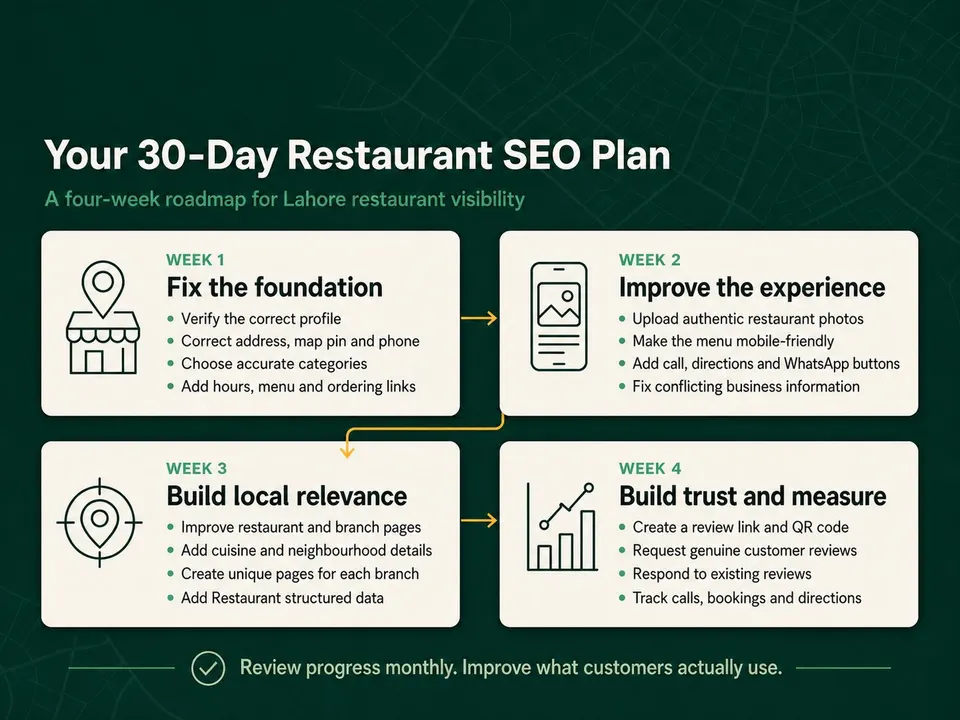
Week 1: Fix the foundation
- Claim and verify the correct Google Business Profile.
- Remove or report duplicate profiles.
- Correct the address, map pin, phone number and opening hours.
- Select accurate categories and attributes.
- Add the menu, booking and ordering links.
Week 2: Improve the customer experience
- Upload original exterior, interior and signature-dish photos.
- Make the website menu readable on mobile.
- Add clear call, directions, reservation and WhatsApp buttons.
- Correct major information conflicts on important platforms.
Week 3: Build local relevance
- Improve the main restaurant or branch page.
- Add neighbourhood, landmark, cuisine and service details naturally.
- Create unique pages for additional branches.
- Add appropriate restaurant structured data.
Week 4: Build reputation and measurement
- Create a review link and QR code.
- Train staff to request genuine reviews consistently.
- Respond to existing reviews.
- Configure analytics and record calls, bookings, orders and direction requests.
After the first month, continue updating operational information, adding useful photographs, responding to reviews and improving pages based on real customer questions.
Frequently asked questions
How long does restaurant SEO take?
Profile edits may appear within days, while new businesses can take longer to surface. Meaningful ranking and conversion improvements often require several weeks or months, depending on the restaurant’s location, competition, prominence and starting position. There is no guaranteed timetable.
Does a restaurant need a website to appear on Google Maps?
Not necessarily. An eligible, verified and complete Google Business Profile can appear in local results without a sophisticated website. However, a good website strengthens the restaurant’s official information and provides better control over menus, branch pages, bookings and measurement.
What matters most for restaurant SEO?
Start with an accurate and verified Google Business Profile, appropriate categories, correct hours, a useful menu, genuine reviews and a strong mobile customer journey. Then improve the website and earn relevant local mentions.
Should restaurant owners add keywords to the Google business name?
Only if those words are part of the restaurant’s genuine real-world name. Adding locations or cuisine keywords solely for rankings can violate Google’s guidelines.
How can a restaurant get more reviews?
Share Google’s review link or QR code with genuine customers and make a polite, neutral request. Never offer a reward or discount in exchange for reviews.
Is a Findoo listing enough to rank a restaurant?
No single listing guarantees a ranking. A complete Findoo profile can support discovery and give customers another path to the restaurant, but it should form part of a broader strategy built around an accurate Google profile, strong customer experience, genuine reputation and useful website content.
Help Lahore customers discover your restaurant
Restaurant SEO works best when every public touchpoint tells the same accurate story: what you serve, where customers can find you, when you are open and how they can order or reserve.
Start with the fundamentals, measure real customer actions and improve the experience continuously. You can also list your restaurant free on Findoo to give Lahore customers another way to discover your menu and contact your business.
Comments
No comments yet. Be the first to share your thoughts.